
Rainwater should flow from your roof into the gutters, through the downspouts, and away from your home’s exterior. But what happens when water slips behind the gutter instead of entering it? You may notice dripping along the fascia, peeling paint beneath the roofline, or damp areas that return whenever it rains.
Water behind gutters is a drainage problem that occurs when roof runoff bypasses the intended collection path and reaches the space between the gutter and the building. The cause may involve incorrect gutter positioning, inadequate flashing, loose attachments, or a poorly designed roof-to-gutter transition.
Unlike a typical gutter overflow, this problem can develop even when the gutters are clean and the downspouts are working properly. That distinction matters because cleaning or replacing an otherwise functional gutter may not correct the underlying defect.
For homeowners in Greentown, Hawley, Tafton, and the Lake Wallenpaupack area, understanding why water travels behind the gutters can help prevent recurring moisture exposure and unnecessary replacement work.
The most effective solution begins with identifying exactly where the runoff leaves its intended drainage path.
Why Does Water Run Behind Gutters Instead of Inside Them?
A properly functioning gutter receives water as it leaves the roof covering and directs it toward the downspouts. The gutter’s location and the surrounding roof-edge details must work together so runoff reaches the collection channel.
When a gap, misalignment, or unsuitable flashing arrangement interrupts this path, water may travel along the underside of a roofing component or pass through the space behind the gutter.
In some situations, the gutter itself is structurally sound. The problem is that water never reaches the trough.
Water behind gutters may therefore indicate an installation or alignment issue rather than a blockage.
How Water Bypasses the Gutter
As rainwater reaches the lower edge of the roof, it should separate from the roofing materials and enter the gutter opening.
If the roof covering, flashing, and gutter do not meet in an appropriate arrangement, water may follow the underside of an edge rather than falling into the gutter.
Surface tension can contribute to this behavior, particularly where a poorly designed edge allows water to cling to a surface.
The resulting runoff may move down the fascia or enter the narrow space between the gutter and the building.
Why a Clean Gutter Can Still Leak Behind It
A common misunderstanding is that water dripping near a gutter must mean the gutter is clogged.
However, water leaking behind gutters can occur even when the trough is empty or draining normally.
If the gutter is positioned incorrectly or the roof-to-gutter transition does not direct runoff into the opening, clearing debris will not solve the problem.
The correct diagnosis depends on observing how water travels from the roof edge into the gutter, not simply checking whether the gutter contains leaves.
6 Common Causes of Water Behind Gutters
Understanding the causes of water behind gutters helps homeowners identify whether the problem requires a minor adjustment, flashing correction, or replacement of a damaged component.
1. Incorrect Gutter Positioning
The location of the gutter relative to the roof edge is one of the most important factors in capturing rainwater.
If the gutter sits too far away from the roofline, water may fall into the gap between the gutter and fascia.
A gutter positioned too low may also fail to intercept runoff effectively, depending on the roof design and flashing arrangement.
Improper gutter installation can create these conditions even when the gutter itself is new and undamaged.
The appropriate position depends on roof geometry, roofing material, gutter profile, and the intended discharge path.
A contractor should assess these factors rather than move every gutter closer to the roof using a fixed measurement.
2. Missing or Improperly Positioned Gutter Apron
A gutter apron is a type of metal flashing used in certain roofing assemblies to help direct water from the roof edge toward the gutter.
Its profile typically extends from the roofing area toward the gutter opening, helping bridge the transition.
When an apron is required by the design but is missing or poorly positioned, runoff may pass behind the gutter.
Common gutter apron problems include unsuitable flashing dimensions, incorrect placement, damaged sections, and poor integration with adjacent roofing materials.
However, not every roof uses the same gutter apron configuration. Some assemblies use other approved roof-edge flashing details.
The important question is whether the installed system directs water safely into the intended drainage path.
3. Gutter Flashing Problems at the Roof Edge
Roof-edge flashing helps manage water where roofing materials meet the building perimeter.
If flashing is bent, loose, damaged, or poorly integrated with the gutter, runoff may reach vulnerable surfaces instead of entering the trough.
These gutter flashing problems may result from previous roofing work, unsuitable metal profiles, or deterioration of existing components.
The visible symptom may be dripping behind the gutter, even when the original defect is located slightly higher along the roof edge.
A professional should evaluate the relationship between the roofing materials, flashing, and gutter without assuming that every moisture problem requires replacing the drip edge.
4. Loose or Sagging Gutter Sections
Gutter hangers and other attachment components help keep the system in its intended position.
Over time, attachments may loosen, allowing sections to shift away from the fascia.
When a gutter pulls outward, the gap between the gutter and roof edge may increase.
This can affect how runoff enters the gutter, especially during steady or heavy rainfall.
Loose attachments may develop because of inadequate fastening, physical damage, or deterioration of the supporting material.
The repair should address both the gutter position and the condition of its attachment points.
Simply tightening fasteners into weakened wood may not provide a reliable long-term solution.
5. An Unsuitable Roof Overhang or Edge Transition
The amount of roof overhang and the shape of the roof-edge components influence how water leaves the roof.
If the edge detail does not provide an appropriate transition toward the gutter, water may travel along an unintended surface.
This may happen even when the gutter appears properly aligned from the ground.
Correcting the problem may require evaluating the roof-edge configuration and flashing together, rather than adjusting the gutter alone.
The objective is to create a reliable path for runoff to enter the gutter without repeatedly wetting the fascia.
6. Problems Following Gutter or Roofing Work
Some cases of rainwater running behind gutters begin after roof repairs, gutter replacement, or other exterior work.
The original flashing may have been disturbed, a gutter may have been reinstalled in a different position, or an attachment may not have been secured correctly.
These changes may remain unnoticed until the first substantial rainfall.
If the problem began shortly after exterior work, the installation history is useful information for the contractor investigating the cause.
However, the timing alone does not establish that the previous work caused the defect.
Water Behind Gutters vs. Gutter Overflow: What Is the Difference?
Although both problems involve unwanted water outside the gutter, they are not the same.
Understanding the difference helps prevent unnecessary maintenance or replacement.
Gutter Overflow
Gutter overflow occurs when water rises above the gutter’s intended capacity or cannot drain away effectively.
Common contributing factors include blocked downspouts, debris accumulation, incorrect slope, insufficient drainage capacity, or unusually heavy rainfall.
Water may spill over the front or rear edge of the gutter after collecting inside it.
The key observation is that water enters the gutter but does not drain or remain contained as intended.
Water Flowing Behind the Gutter
When water travels behind the gutter, it may bypass the collection channel entirely.
You may see water running down the fascia while the gutter itself contains relatively little water.
This pattern suggests that the gutter position, flashing, or roof-edge transition deserves attention.
However, a gutter overflowing over its rear edge can produce a similar appearance, so the actual water path must be identified.
Why the Repair Is Different
Overflow problems may require clearing obstructions, correcting drainage slope, or addressing gutter capacity.
Water bypassing the gutter may require repositioning the trough, correcting flashing, or repairing loose attachments.
Cleaning alone will not necessarily correct an installation defect, while replacing flashing will not remove a downspout obstruction.
Identifying how the water moves is more important than treating every visible drip as the same problem.
Signs That Water Is Leaking Behind Your Gutters
Not every drainage defect is visible during dry weather.
Some warning signs become noticeable only when rainwater is moving across the roof.
Dripping Between the Gutter and Fascia
One of the clearest symptoms is water dripping through the gap behind the gutter.
You may observe water between gutter and fascia surfaces while rainfall continues.
This suggests that runoff is entering an area outside the intended collection path, although the source may be a roof-edge defect or rear gutter overflow.
Dark Streaks Along the Fascia
Recurring moisture may leave discoloration or streaks beneath the gutter.
These marks can develop where water repeatedly travels across painted or finished surfaces.
The pattern may help indicate where water is escaping, but stains alone do not prove which component is responsible.
Peeling Paint Beneath the Roofline
Repeated wetting can affect painted exterior finishes.
If paint begins peeling or blistering directly beneath a gutter, unwanted moisture exposure may be contributing.
Other causes are possible, so the condition should be assessed alongside the gutter and flashing arrangement.
Moisture Around Gutter Attachments
Water may collect or drip near hangers, fasteners, or attachment points.
These areas deserve attention because repeated moisture exposure can affect the materials supporting the gutter.
However, the presence of water near a fastener does not automatically mean the fastener is defective.
Gutter Sections Pulling Away From the House
A visible gap or sagging gutter section may indicate that the attachments are no longer maintaining the intended position.
This can allow runoff to bypass the gutter, particularly when the separation affects the roof-to-gutter transition.
The supporting material should also be evaluated before attempting to reattach the gutter.
How to Identify Where Water Is Coming From
Before deciding how to repair water behind gutters, it helps to gather observations about when and where the problem occurs.
Homeowners can document visible symptoms from a safe location without climbing onto the roof.
Observe the Gutter During Rainfall From a Safe Position
If conditions allow, look at the gutter from the ground or a protected indoor location during ordinary rainfall.
Pay attention to whether water is overflowing from the trough or dripping directly behind it.
Do not stand beneath unstable gutters, enter areas exposed to falling debris, or attempt roof access during wet weather.
The goal is to observe the drainage pattern safely, not perform a hands-on inspection.
Identify Whether Water Enters the Gutter
A useful distinction is whether runoff reaches the gutter before escaping.
If water enters the trough and then spills over an edge, drainage capacity or an obstruction may be involved.
If water appears to pass behind the gutter without entering it, the roof-edge transition or gutter alignment may be the concern.
Some installations experience more than one problem, so both conditions should remain possible.
Look for Localized or Continuous Dripping
Water appearing behind one short section may indicate a localized alignment, joint, or attachment issue.
Dripping along a long section may suggest a broader positioning or flashing problem.
This pattern helps guide further assessment, although it is not enough to determine the repair by itself.
Record When the Problem Started
If the symptoms began after gutter installation, roof replacement, or exterior repairs, record the approximate timing.
Photographs taken from a safe position can also help a professional understand the drainage behavior.
Information about recent work and recurring rainfall conditions may make the inspection more efficient.
Have the Roof-to-Gutter Transition Examined
A qualified professional can assess the position of the gutter, the condition of its attachments, and how the flashing directs runoff.
The evaluation should identify the first point where water leaves its intended path.
This avoids replacing otherwise functional components while leaving the actual defect unresolved.
Can Water Behind Gutters Cause Roof Damage?
Yes. Persistent water behind gutters can expose materials near the roof perimeter to repeated moisture.
The extent of damage depends on the water pathway, frequency of exposure, material condition, and how long the problem continues.
Not every drainage defect leads to structural damage, but recurring moisture deserves attention.
Moisture Exposure Along the Fascia
Fascia boards form part of the roof perimeter and frequently provide a mounting surface for gutters.
When water repeatedly reaches the fascia, paint and protective finishes may deteriorate.
If wood remains wet for extended periods, conditions may eventually support decay.
However, a stained fascia board is not necessarily rotten and should not automatically be replaced without evaluation.
Moisture Around Soffits and Roof Edges
Depending on the roof design, runoff traveling behind the gutter may reach the soffit or exposed edges of adjacent materials.
This can create moisture stains or affect susceptible finishes.
The severity depends on whether water is reaching concealed spaces or simply running over an exterior surface.
Weakening Gutter Attachment Points
Repeated wetting may affect the materials into which gutter fasteners are installed.
If the supporting surface deteriorates, the gutter may become less securely attached.
As the gutter shifts, its ability to receive runoff may decline further.
This creates a cycle in which the original moisture problem contributes to additional misalignment.
When Water Damage Behind Gutters Requires Attention
Visible deterioration, loose attachments, persistent dampness, or increasing stains should prompt professional evaluation.
Water damage behind gutters may be limited to finishes, or it may involve adjacent wood components.
The actual condition should be established before deciding whether repair or replacement is necessary.
How to Fix Water Leaking Behind Gutters
The best repair depends on identifying why water is bypassing the gutter.
There is no single solution suitable for every roof design.
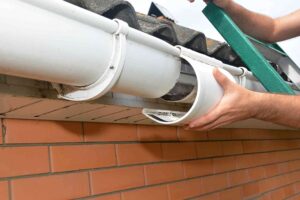
1. Correct the Gutter Position
If the gutter is in good condition but incorrectly positioned, adjusting its mounting location may improve the runoff collection path.
The contractor should evaluate the distance from the roof edge, gutter height, slope, and relationship with adjacent flashing.
The objective is to allow water to enter the trough without creating unnecessary contact with vulnerable roof-edge materials.
Moving a gutter without checking the flashing arrangement may fail to solve the problem.
2. Repair the Gutter Apron or Transition Flashing
If the roof design uses a gutter apron, the contractor should evaluate whether it extends and overlaps the surrounding components appropriately.
A missing, unsuitable, or damaged apron may need correction or replacement.
However, installing additional flashing is not automatically the right solution for every building.
The work must follow the appropriate water-shedding arrangement for the roofing system.
3. Correct Damaged Roof-Edge Flashing
When flashing is loose, displaced, or damaged, the affected sections may require repair or replacement.
The work should restore the intended drainage path rather than simply conceal visible gaps.
For problems involving roofing materials or defective roof-edge details, Wallenpaupack Roofers offers professional roof repair services for homeowners in Greentown and surrounding communities.
The repair scope should reflect the actual defect and the condition of surrounding materials.
4. Reattach Loose Gutter Sections
If the gutter has shifted because of loose or damaged hangers, the contractor may need to replace fasteners or correct the mounting arrangement.
Before reattaching the gutter, the supporting fascia should be checked to determine whether it can securely hold the system.
The corrected installation should maintain the gutter’s intended position and drainage slope.
5. Replace Gutters When They Are No Longer Serviceable
Some systems can be repaired through localized adjustment or new attachments.
However, gutters that are severely damaged, incorrectly sized, extensively deteriorated, or unable to remain securely installed may require replacement.
Wallenpaupack Roofers provides seamless gutter installation and replacement services for residential properties in Greentown, PA, and nearby Lake Wallenpaupack communities.
Replacing the gutter should be based on its condition and the drainage requirements of the property, not simply the presence of water behind it.
Will Caulking Between the Gutter and Fascia Stop the Leak?
Applying caulk behind the gutter may seem like a quick solution, especially when water is visibly passing through a narrow gap.
However, sealing the gap does not necessarily correct the reason runoff is traveling there.
If the gutter is too far from the roof edge, the flashing is incorrectly positioned, or the water-shedding transition is defective, surface sealant may only redirect or temporarily conceal the problem.
In some situations, inappropriate sealing can also interfere with the intended drainage or drying of surrounding components.
The correct approach is to restore the path that directs rainwater into the gutter.
Sealants should only be used where appropriate for the specific installation detail and according to relevant product requirements.
Does Water Behind Gutters Always Mean They Need Replacement?
No. Many cases of water behind gutters involve a correctable installation or alignment issue rather than failure of the entire gutter system.
A sound gutter may only need repositioning or attachment correction.
In other situations, the gutter may be functioning properly while the roof-edge flashing requires attention.
Replacement becomes more reasonable when the gutter itself is extensively damaged, deteriorated, or unsuitable for the property’s drainage needs.
A professional assessment should distinguish between component failure and an incorrect relationship between otherwise serviceable components.
This helps homeowners avoid paying for a new gutter system that does not resolve the original water pathway.
How to Prevent Rainwater From Running Behind Gutters
Preventing recurring problems begins with proper installation and attention to the relationship between roof runoff and the gutter system.
Ensure the Roof and Gutter Work Together
During installation or replacement, the contractor should confirm that water can move from the roof covering into the gutter without passing behind it.
The roof-edge flashing, gutter height, attachment position, and roof geometry should be assessed as a complete arrangement.
Check for Visible Gutter Movement
From a safe position, look for sections that appear loose, tilted, or separated from the fascia.
Visible movement may indicate that attachments require professional attention.
Correcting misalignment early can help prevent additional runoff from reaching unintended surfaces.
Keep Downspouts and Outlets Clear
Although blockages are not the only cause of rear gutter leakage, functional outlets and downspouts remain important.
Obstructions can produce overflow that resembles water bypassing the gutter.
Regular maintenance helps keep drainage functioning and makes unusual water behavior easier to identify.
Check Drainage After Exterior Work
Roof replacement, gutter installation, and other exterior projects can change the relationship between the roof edge and gutter.
After work is completed, observe drainage during the next suitable rainfall from a safe location.
If runoff appears behind the gutter, contact the contractor for an assessment rather than attempting to alter the installation yourself.
Avoid Unsafe DIY Repairs
Working along the roof perimeter involves fall hazards and can damage roofing or gutter components if performed incorrectly.
Homeowners should avoid climbing onto wet roofs, lifting shingles, or adjusting high gutters without appropriate training and equipment.
A qualified professional can evaluate concealed details and carry out corrections safely.
Water Behind Gutters in Greentown and Lake Wallenpaupack, PA
Homes around Greentown, Hawley, Lakeville, Tafton, and Lake Wallenpaupack experience seasonal rainfall, snowmelt, and changing temperatures.
These conditions make reliable drainage particularly important for protecting exterior building materials.
During heavy rainfall, larger volumes of runoff move toward the roof edge. If the gutter and flashing are poorly aligned, water may bypass the collection channel.
Snowmelt can also expose existing drainage defects as water moves across roofing materials and reaches the gutter system.
However, weather conditions alone do not establish why a particular gutter is leaking.
Correct gutter positioning, suitable flashing details, secure attachments, and functional drainage outlets remain the key considerations.
For homeowners in Northeast Pennsylvania, investigating persistent dripping behind the gutter can help identify the appropriate correction before repeated moisture exposure affects surrounding finishes or supporting materials.
Water Running Behind Your Gutters? Contact Wallenpaupack Roofers
If rainwater is bypassing your gutters, the problem may involve gutter alignment, flashing, attachment points, or the relationship between the roof edge and gutter opening.
Replacing the entire system is not always necessary. The important first step is identifying the actual cause.
Wallenpaupack Roofers serves homeowners and property owners in Greentown, PA, and surrounding Lake Wallenpaupack communities with gutter installation, replacement, and related roofing services.
Whether you have noticed dripping behind a clean gutter, loose attachments, or recurring moisture along the roofline, our team can discuss your concerns and the appropriate next steps.
Call (570) 390-3166 or contact Wallenpaupack Roofers to request a gutter assessment. Tell us where the water appears and when the problem occurs so we can better understand your property’s drainage needs.
Frequently Asked Questions About Water Behind Gutters
Why is water running behind my gutters instead of inside them?
Water can bypass a gutter because of incorrect positioning, unsuitable flashing, loose attachments, or a poorly integrated roof-to-gutter transition. The actual drainage path should be evaluated before selecting a repair.
Can water leak behind gutters when they are not clogged?
Yes. Water can pass behind a clean gutter when the roof runoff does not enter the trough correctly. Gutter alignment and roof-edge details should be checked rather than assuming debris is responsible.
What causes water between gutter and fascia surfaces?
Water between gutter and fascia may result from runoff bypassing the gutter opening, rear gutter overflow, or a defective roof-edge transition. Observing the drainage pattern can help distinguish the possible causes.
What are the most common gutter apron problems?
Common issues include missing apron flashing where required, poor positioning, inadequate dimensions, damage, and unsuitable integration with adjacent roofing materials. The correct arrangement depends on the roof assembly.
Can water behind gutters damage my roof?
Repeated wetting may affect fascia finishes, gutter attachment surfaces, soffits, and adjacent roof-edge materials. However, the presence of water does not automatically mean structural damage has occurred.
Will sealing the gap behind my gutter solve the problem?
Not necessarily. Caulking may conceal the visible gap without correcting incorrect gutter positioning or flashing. A reliable repair should restore the intended drainage path.
Do I need new gutters if water is leaking behind them?
Not always. If the gutter remains sound, repositioning, attachment correction, or flashing repair may be sufficient. Replacement should depend on the condition of the system and its drainage requirements.
Who should I contact about water behind gutters in Greentown, PA?
A qualified roofing or gutter professional can examine the roof-to-gutter transition and determine whether the issue involves alignment, flashing, attachments, or the gutter itself. Wallenpaupack Roofers serves Greentown and nearby Lake Wallenpaupack communities.