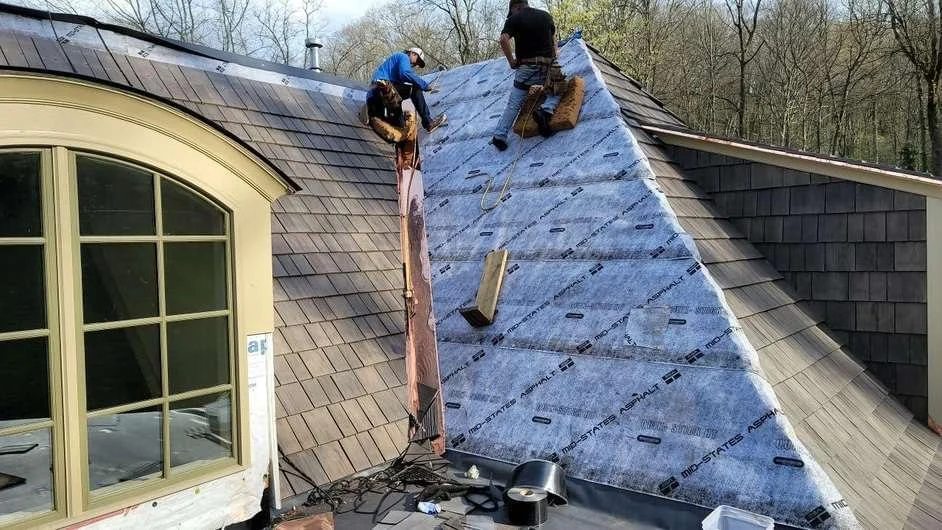
When rainwater reaches the point where two roof slopes meet, it flows into a narrow channel known as a roof valley. This area carries runoff from both adjoining surfaces, making it one of the most important drainage points on a sloped roof. If the materials protecting that channel become damaged or incorrectly installed, water may find a path beneath the roofing system.
A roof valley leak can develop because of damaged flashing, displaced shingles, obstructed drainage, or problems with the protective layers beneath the visible roof covering. However, identifying the actual cause requires more than locating a ceiling stain. Water can travel along hidden surfaces before appearing inside the home, making a valley-related leak difficult to diagnose without examining the roofing assembly.
For homeowners in Greentown, Hawley, Tafton, and the Lake Wallenpaupack area of Pennsylvania, roof valleys deserve particular attention during heavy rainfall, snowmelt, and periods of seasonal debris accumulation.
The important question is not simply whether the roof valley is leaking, but why water is leaving its intended drainage path. Understanding that distinction helps homeowners avoid repeated temporary repairs and make more informed decisions about professional roofing work.
This guide explains seven common causes of roof valley leaks, how to recognize the warning signs, what distinguishes flashing problems from shingle damage, and which repair options may be appropriate.
What Is a Roof Valley and How Does It Drain Water?
A roof valley is the inward-sloping intersection where two roof planes meet. Instead of directing runoff away from the joint, the geometry of the roof causes water from both slopes to converge in the valley and flow downward toward the eaves.
Because the valley receives water from multiple sections, its drainage conditions differ from those of a typical shingle-covered roof slope.
The roofing components installed in this area must form a continuous water-shedding arrangement that accommodates concentrated runoff.
Why Roof Valleys Are Vulnerable to Water Intrusion
Rainwater traveling down a roof slope generally follows the direction of the shingle courses.
At a valley, however, water from two surfaces enters the same channel. The depth and speed of the runoff can increase during intense rainfall, depending on the roof’s geometry and drainage area.
If shingles, flashing, or underlying protective materials fail to direct water through the channel, moisture may move beneath the intended covering.
The resulting leak may be limited to one small defect or involve several adjacent roofing components.
Open Valley vs. Closed Valley Roofing Systems
The construction of a roof valley influences how water is managed and which problems may occur.
In an open valley, shingles terminate along both sides of an exposed metal channel. The metal flashing carries runoff between the adjoining roof slopes.
In a closed-cut valley, shingles from one slope extend across the valley, while shingles from the adjoining slope are cut along a specified line. The arrangement directs water over the surface without leaving a wide exposed metal channel.
A woven valley uses shingles interlaced across the intersection. This configuration is not appropriate for every shingle product, particularly some laminated or architectural shingles, so the selected manufacturer’s installation instructions must determine whether it can be used.
None of these methods is automatically defective simply because it differs from another roof.
An effective valley depends on compatible materials, proper construction, adequate underlying protection, and a clear drainage path.
7 Common Causes of a Roof Valley Leak
A roof valley leak generally occurs when water escapes the intended drainage channel or penetrates through a defect in the protective assembly.
The following causes require different inspection methods and should not all be treated with the same repair.
1. Damaged or Corroded Valley Flashing
Metal valley flashing provides a protective drainage surface in open-valley systems.
If the metal develops punctures, significant corrosion, displacement, or defective joints, water may reach areas beneath the flashing.
A roof valley flashing leak can also result from incorrect overlap or poorly integrated surrounding materials.
However, discoloration or ordinary surface weathering does not necessarily mean the flashing has failed.
A roofing professional should determine whether the condition affects water flow or creates a pathway into the underlying roof assembly.
2. Cracked or Displaced Valley Shingles
Closed-valley systems depend on carefully positioned shingles to maintain the intended water-shedding pattern.
If shingles crack, tear, become loose, or shift out of alignment, water may reach a vulnerable area.
Damaged roof valley shingles may develop through weather exposure, physical damage, aging, or incorrect installation.
Their position is important because a small defect within the concentrated water pathway may have different consequences from similar damage on a less exposed roof surface.
The contractor should assess the affected shingles and surrounding materials before determining the repair scope.
3. Incorrect Valley Installation
A roof valley must be constructed according to the roofing product’s approved installation details.
Problems may occur when shingles are cut in the wrong location, flashing is installed with insufficient overlap, or fasteners penetrate areas where the manufacturer prohibits them.
An incorrectly formed valley may look acceptable from the ground yet allow water to enter during certain weather conditions.
These defects can become especially noticeable when rainfall increases the amount of runoff moving through the channel.
Correcting the installation detail may require removing affected materials rather than applying sealant to the visible surface.
4. Heavy Debris Accumulation
Leaves, pine needles, twigs, and other materials may collect along roof valleys, particularly on properties surrounded by mature trees.
Accumulated debris can restrict runoff, retain moisture, or redirect water toward adjacent roofing components.
A leaking roof valley associated with debris may improve after the obstruction is removed, but cleaning alone is not always sufficient.
The contractor should determine whether the trapped material has concealed an existing defect or contributed to damage near the drainage channel.
Homeowners should avoid climbing onto steep or slippery roofs to remove debris themselves.
5. Deteriorated Valley Underlayment
Beneath the visible shingles or flashing, roofing systems commonly include protective underlayment or specialized leak-barrier materials.
These layers help protect the roof deck when water reaches areas beneath the exterior covering.
If the underlying protection is damaged, incorrectly positioned, or compromised during previous work, moisture may reach vulnerable materials.
Because these components are concealed, their condition may not be clear from exterior photographs.
A professional investigation may be necessary to determine whether the problem affects the underlying assembly.
6. Improper Shingle Cutting or Alignment
Certain closed-valley systems require shingles to be cut and aligned in specific locations relative to the center of the valley.
Incorrect cutting can interfere with the intended water pathway or expose areas that should remain protected.
Poor alignment may also create irregular edges that collect debris or direct runoff beneath neighboring shingles.
The correct cutting pattern depends on the roofing product and installation method.
A contractor should restore the intended arrangement rather than assume that widening the visible drainage channel will solve the problem.
7. Incomplete Previous Repairs
A recurring roof valley leak may indicate that an earlier repair did not address the actual source of water intrusion.
For example, patching a visible gap may not resolve incorrectly installed flashing beneath adjacent shingles.
Similarly, applying sealant near an interior stain may have little effect if water enters farther upslope.
When a repair fails, the next inspection should consider the complete affected valley detail, including previous work and the surrounding drainage path.
The objective is to correct the source of the problem rather than repeatedly cover its symptoms.
Warning Signs That Your Roof Valley May Be Leaking
Not every visible irregularity indicates active water intrusion, but certain patterns suggest that professional evaluation is appropriate.
Interior Water Stains Near a Valley
A ceiling stain beneath or near the intersection of two roof slopes may indicate moisture intrusion.
However, the location of the stain does not necessarily identify the entry point.
Water may travel along framing, roof decking, or other concealed materials before reaching the interior.
Leaks That Appear During Heavy Rain
Some valley defects only produce noticeable symptoms during intense or prolonged rainfall.
The increased volume of runoff may expose a weakness that remains unnoticed during lighter precipitation.
Recording when the leak occurs can help a contractor investigate the possible cause.
Visible Gaps or Missing Materials
Missing shingles, displaced flashing, or unusual gaps along a valley can indicate that protective materials are no longer in their intended position.
These conditions are particularly worth investigating after strong winds or storm damage.
Repeated Debris Buildup
Leaves and other materials that repeatedly collect in the same valley section may indicate a drainage restriction or surface irregularity.
The presence of debris alone does not prove that the roof is leaking, but it may justify closer evaluation.
Moisture Marks on Accessible Attic Materials
Water staining on accessible sheathing or framing may help identify where moisture has traveled.
However, attic stains may be located some distance from the actual exterior defect.
Avoid disturbing unsafe attic areas, damaged electrical components, or unstable materials while checking for visible signs.
How to Diagnose a Roof Valley Leak More Accurately
A successful investigation should distinguish between the location where water becomes visible and the location where it enters the roofing assembly.
The following observations can help narrow the possibilities without requiring homeowners to access the roof.
Step 1: Record When the Leak Appears
Note whether moisture becomes visible during brief heavy storms, prolonged rainfall, or snowmelt.
Also record whether the problem occurs only when wind accompanies the rain.
These details cannot confirm the source independently, but they can provide useful context.
Step 2: Identify the Roof Valley Above the Affected Area
From a safe location, observe the general roof geometry.
Determine whether two roof slopes meet above or near the area where moisture has appeared.
Keep in mind that water may travel before reaching an interior ceiling or wall.
Step 3: Observe Visible Conditions Along the Valley
Look for displaced materials, heavy debris, exposed or distorted flashing, and changes in the surrounding shingles.
Take dated photographs from safe ground-level positions where possible.
Do not climb onto the roof to inspect or touch the valley components.
Step 4: Compare the Current Problem With Previous Repairs
If the area has leaked before, gather earlier photographs, repair records, and inspection notes.
Repeated symptoms following similar weather conditions may indicate that the original cause remains unresolved.
Step 5: Confirm the Entry Point Professionally
A qualified contractor should evaluate the relevant roof surfaces, valley construction, and evidence of water movement.
The goal is to determine whether the problem is actually within the valley or originates from another point farther upslope.
For broader information about tracing roof leaks from different sources, homeowners can review our existing roof leak repair guide.
This article focuses specifically on the valley drainage channel rather than all possible roof leak locations.
Roof Valley Flashing Leak vs. Valley Shingle Damage
A metal flashing problem and a shingle problem may produce similar interior symptoms, but the appropriate repairs can be different.
When the Problem Involves Metal Flashing
In an open valley, a professional may identify corrosion, physical damage, displacement, or defective flashing overlaps.
The inspection focuses on whether water can remain within the intended metal channel and flow toward the eaves.
If the flashing is compromised, replacement or correction of the affected detail may be necessary.
Nearby shingles and protective layers should also be assessed.
When the Problem Involves Valley Shingles
In a closed valley, the contractor examines shingle alignment, cuts, overlaps, and visible deterioration near the intersection.
A displaced shingle may expose an underlying area, while an incorrect cutting pattern may direct water beneath adjacent roofing materials.
Correction should restore the appropriate configuration for the selected system.
When Both Flashing and Shingles Are Affected
Some problems involve several roofing components.
For example, an incorrectly installed valley may contain displaced shingles above unsuitable flashing details.
In these situations, repairing only the most visible material may leave the original water pathway unchanged.
The scope should be based on the actual condition of the affected assembly.
How Roof Valley Construction Affects Leak Risk
The difference between open, closed-cut, and woven valleys matters because each design manages runoff through a specific arrangement of roofing materials.
Open Valleys
Open valleys rely on exposed metal flashing to carry concentrated runoff.
A professional inspection may evaluate the metal surface, placement, joints, and adjacent shingle edges.
If the flashing has failed, the corrective work should restore a continuous drainage channel compatible with the surrounding roofing system.
Closed-Cut Valleys
Closed-cut valleys use shingles arranged in a specified overlap pattern.
The placement of the cut line and the orientation of the shingle courses matter because they influence how water passes through the valley.
Incorrect cuts or misplaced fasteners may compromise the intended protection.
Woven Valleys
Woven valleys interlace shingles from adjoining slopes across the valley.
However, this method is not appropriate for every roofing material.
Some architectural or laminated shingle products prohibit woven valley installations or require an alternative method.
The selected shingle manufacturer’s instructions should determine whether a woven valley is acceptable.
Why the Existing System Matters
A repair should not automatically convert one valley type into another.
The contractor must consider the roof’s slope, existing materials, underlying protection, and the applicable installation requirements.
The priority is restoring an effective water-shedding arrangement, not choosing a valley type solely because it appears visually different.
What Happens if a Roof Valley Leak Continues?
When water enters through a compromised valley assembly, the resulting damage may extend beyond the visible exterior defect.
The consequences depend on the duration of the problem, the quantity of water entering, and which materials become affected.
Damage to Roof Decking
Water reaching the roof deck can affect susceptible materials over time.
Depending on the deck construction and moisture exposure, deterioration may develop beneath the valley.
However, roof valley water damage should be established through appropriate evaluation rather than assumed from exterior staining alone.
Wet Attic Insulation
If moisture passes through the roofing assembly, nearby attic insulation may become wet.
The effect depends on the insulation material, extent of exposure, and surrounding building conditions.
Correcting the roof leak is important before deciding how affected interior materials should be addressed.
Interior Ceiling and Wall Damage
Moisture may eventually become visible as ceiling stains, damaged paint, or deteriorated interior finishes.
These symptoms can appear away from the original valley defect because water may move along concealed surfaces.
Repairing the interior appearance without correcting the roof leak may allow the problem to return.
Repeated Moisture Exposure
An unresolved leak can expose the same building materials to water during successive storms.
Over time, this may increase the extent of deterioration and complicate future repair work.
Early investigation helps determine whether the problem remains localized.
Roof Valley Repair: Choosing the Correct Solution
The appropriate roof valley repair depends on what caused the water to leave its intended drainage path.
A localized flashing defect requires a different response from an incorrectly constructed valley or damaged underlying materials.
Clearing an Obstructed Valley
If accumulated debris is preventing runoff from moving freely, safe professional cleaning may restore drainage.
However, the surrounding roofing materials should be checked for damage or deterioration.
Removing leaves will not correct a punctured flashing section or improperly installed shingles.
Repairing Damaged Valley Flashing
A limited flashing defect may be repairable when the surrounding assembly remains suitable and the proposed method is compatible with the roofing system.
Significant corrosion, displacement, or incorrect construction may require replacement of the affected flashing.
The contractor should maintain proper integration with adjacent shingles and protective layers.
Replacing Damaged Valley Shingles
Where the problem involves a limited number of damaged shingles, compatible replacement materials may restore the intended covering.
The existing overlap and cutting pattern must be considered.
If nearby shingles remain incorrectly positioned, replacing only the visibly damaged pieces may not resolve the problem.
Correcting an Improperly Installed Valley
A valley constructed with incorrect overlaps, unsuitable materials, or misplaced fasteners may require partial reconstruction.
This can involve removing affected shingles or flashing to restore the intended water pathway.
The repair should follow the applicable product instructions rather than rely on temporary surface treatment.
Addressing Underlying Damage
If inspection reveals damaged underlayment, deteriorated decking, or other compromised materials, the repair scope may need to include those components.
The decision should reflect verified conditions.
A roof valley leak does not automatically mean that every part of the roof requires replacement.
When Localized Repair May Be Sufficient
A limited repair may be appropriate when the source of water intrusion is identifiable, surrounding materials remain sound, and the cause can be corrected without extensive removal.
Wallenpaupack Roofers provides professional roof repair services for homeowners in Greentown, PA, and surrounding Northeast Pennsylvania communities.
A professional assessment can help determine which corrective work is appropriate for the affected valley.
Why Sealant Alone May Not Stop a Leaking Roof Valley
Applying roofing cement or sealant over a suspected opening may seem like a straightforward solution.
However, a valley relies on correctly arranged materials that direct runoff through the drainage channel.
If the problem involves incorrect flashing overlap, damaged shingles, or an unsuitable installation detail, surface sealant may not restore the intended water-shedding function.
Some roofing systems allow specific compatible sealants in designated applications.
Those materials should be used according to the applicable manufacturer requirements.
Excessive sealant can also make future investigation more difficult by concealing the original condition.
A lasting repair should correct the component or detail responsible for water intrusion rather than simply cover the visible symptom.
When Is More Extensive Roof Valley Repair Necessary?
A small roof valley defect may be resolved through targeted work, but some conditions justify evaluating a larger section.
Repeated Leaks After Earlier Repairs
When leaks return following previous patching, the underlying water pathway may not have been corrected.
A contractor should review the earlier repair details and inspect the affected valley assembly.
Widespread Valley Material Deterioration
Several damaged shingles, extensive flashing deterioration, or repeated defects along the same channel may require broader corrective work.
The extent should be based on the actual damage rather than the assumption that every valley problem requires complete roof replacement.
Moisture Damage Beneath the Surface
If water has compromised underlying roofing components, repairing the exterior covering alone may be insufficient.
Affected materials should be evaluated as part of the overall repair scope.
Incorrect Valley Construction
When a valley was built using unsuitable materials or incorrect installation details, restoring the proper configuration may require removing a larger affected section.
The objective is to correct the system rather than repeatedly repair the same visible symptom.
How to Help Prevent Roof Valley Leaks
Routine monitoring and appropriate maintenance can help homeowners identify conditions that may interfere with roof valley drainage.
Prevent Heavy Debris Accumulation
Leaves, pine needles, and other materials should not obstruct the valley channel.
Homes surrounded by trees may require additional attention during seasonal leaf fall.
Professional cleaning may be appropriate when debris cannot be addressed safely from the ground.
Check for Visible Changes After Storms
Strong winds and falling debris can affect roofing materials near valleys.
Homeowners can document visible changes from safe locations and arrange an inspection when damage is suspected.
Keep Records of Previous Valley Problems
Photographs, repair notes, and inspection reports can help contractors understand recurring symptoms.
If a leak consistently returns after similar weather conditions, previous records may help guide the investigation.
Schedule Professional Roof Inspections
A professional inspection can evaluate visible valley materials, surrounding shingles, flashing conditions, and potential drainage concerns.
Homeowners can learn more about available roof inspection and maintenance services when they want to assess roofing conditions before additional problems develop.
Avoid Unsafe DIY Repairs
Roof valleys are often located on steep or elevated sections.
Wet roofing surfaces, damaged materials, and nearby roof edges can create serious hazards.
Direct inspection, debris removal, and repairs requiring roof access should be handled by appropriately qualified professionals.
Roof Valley Leaks in Greentown and Lake Wallenpaupack, PA
Homes throughout Greentown, Hawley, Tafton, Lakeville, and surrounding Lake Wallenpaupack communities experience changing seasonal weather conditions.
Heavy rainfall can increase the volume of water traveling through roof valleys.
Snowmelt may create additional runoff, while falling leaves and other debris can interfere with drainage during certain seasons.
These conditions can expose weaknesses in existing roofing details, but they do not automatically establish why a particular valley is leaking.
The actual cause depends on the roof’s construction, materials, age, maintenance history, and visible condition.
For homeowners in Northeast Pennsylvania, investigating a recurring roof valley leak can help determine whether the problem involves routine drainage maintenance, localized roofing damage, or a defect requiring more extensive correction.
Roof Valley Leak After Heavy Rain? Get the Source Checked
A roof valley leak can be difficult to diagnose because water often travels beyond the original entry point before becoming visible inside your home.
The problem may involve damaged flashing, displaced shingles, accumulated debris, or an installation detail that no longer directs runoff correctly.
Wallenpaupack Roofers provides residential roofing services in Greentown, PA, and nearby Lake Wallenpaupack communities, including professional roofing inspections and repairs.
If you notice moisture during heavy rainfall, visible damage along a roof valley, or leaks that continue after previous repairs, our team can assess the roofing conditions and discuss suitable next steps.
The priority is identifying the actual source of water intrusion before recommending corrective work.
A properly evaluated repair may address a limited defect without requiring unnecessary replacement of otherwise sound roofing materials.
Call (570) 390-3166 or contact Wallenpaupack Roofers to request a professional roof assessment. Let us know when the leak occurs, where you have noticed moisture, and whether the problem has appeared before.
Frequently Asked Questions About Roof Valley Leaks
What causes a roof valley leak during heavy rain?
Heavy rainfall increases runoff through the valley and may expose damaged flashing, incorrect shingle placement, obstructed drainage, or other defects. The source should be confirmed through professional assessment.
How can I tell if my roof valley is leaking?
Possible signs include water stains near a valley, recurring moisture after rainfall, displaced roofing materials, and visible flashing damage. However, an interior stain does not prove that the valley is the entry point.
Can damaged roof valley shingles cause water intrusion?
Yes. Cracked, displaced, or improperly installed shingles may compromise the protective arrangement, particularly in closed-valley systems.
What is the difference between an open and closed roof valley?
An open valley uses an exposed metal drainage channel between shingle edges. A closed valley uses shingles to cover the intersection according to an approved installation pattern.
Are woven roof valleys suitable for architectural shingles?
Not always. Some laminated or architectural shingle products prohibit woven valleys. The applicable manufacturer’s instructions determine whether the configuration is permitted.
Can roof valley flashing be repaired without replacing the roof?
Yes, in some cases. Localized flashing defects may be corrected without full roof replacement when surrounding materials remain suitable and the repair follows the relevant system requirements.
Can leaves cause a roof valley to leak?
Accumulated leaves and debris can obstruct or redirect runoff. However, the presence of debris alone does not prove that water has entered the roof assembly.
Will roof sealant permanently fix a leaking roof valley?
Not necessarily. Sealant cannot reliably correct every flashing defect, incorrect shingle arrangement, or damaged underlying component. The repair should address the actual cause.
Can a roof valley leak damage the attic?
Yes. Water entering through compromised valley materials may reach roof decking, attic insulation, or framing. The extent of damage depends on the conditions and should be professionally evaluated.
Does a leaking roof valley mean I need a complete roof replacement?
No. Many valley leaks involve localized defects. Complete roof replacement should be considered only when the condition of the broader roofing system justifies it.
Who should I contact for roof valley repair in Greentown, PA?
A qualified roofing contractor can inspect the affected valley, identify the cause of water intrusion, and determine an appropriate repair scope. Wallenpaupack Roofers provides roofing services in Greentown and surrounding Northeast Pennsylvania communities.